by Maggie A. Clark
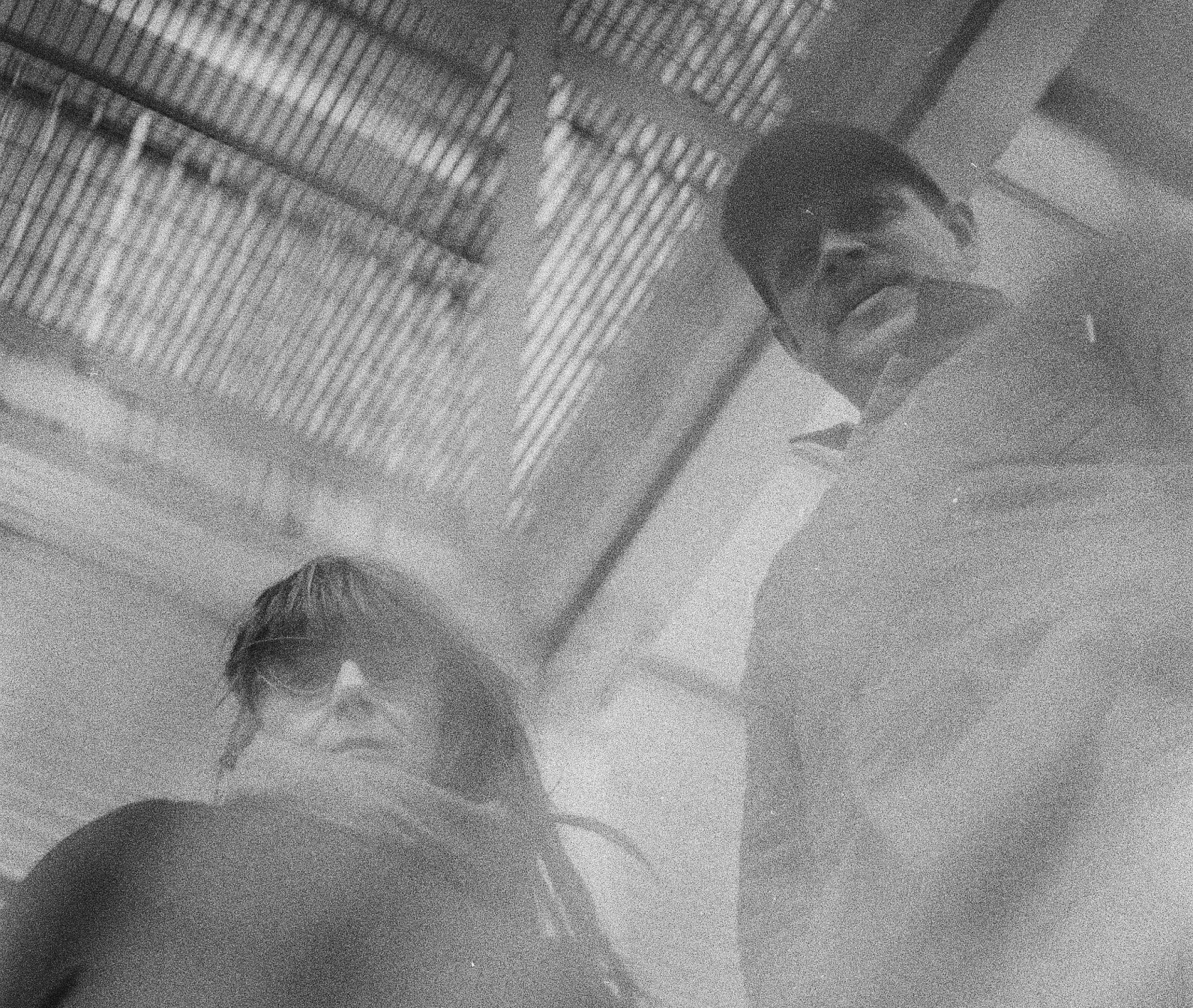
Cloud Circuit are a duo from Montréal whose work could be described using some combination of the following phrases, preferably chopped up and arranged in an arbitrary yet mellifluous order: musique concrète, found sound, electroacoustic, deconstructed poetry. On June 12, they put out a self-titled album, their first studio release in six years. Stylus sat down with Deanna Radford (Stylus editor, 2000–2003) and Jeremy Young to talk about the new album, its resonances, and the future of the music commodity form. The two of them were sitting in front of a wall of analogue sound equipment, eating out of a large bowl of popcorn.
Our interview has been edited for clarity and conciseness. Even more so than usual, I’d say.
Stylus: So, Deanna, here’s a question I have to ask all Winnipeg expats: why did you leave? What’s so cool about Montréal?
Jeremy Young (JY): God, just digging right in, aren’t you?
Deanna Radford (DR): I didn’t move away from Winnipeg; I moved toward Montreal. I didn’t leave because I didn’t love Winnipeg. I moved for love.
JY: Not me, by the way. This isn’t—
DR: Yeah, he’s like my brother. My partner at the time had a job offer, and Montréal — we went there all the time to see music and art, and the proximity to the firehose of creativity was super stimulating to me. That relationship didn’t pan out, but I felt like I still had shit to do here. I had questions to figure out the answers to, creatively and otherwise.
Stylus: Your bio describes Cloud Circuit as consisting of “Deanna Radford on deconstructed word events, and Jeremy Young on tape, sine waves, and radio.” Two questions come to mind from this: one, what makes a word an event? And two, what draws you to tape manipulations and radio waves as a medium of sound conveyance?
DR: I think Jeremy should go first.
JY: As you can see behind me, my studio is chock-full of analogue, half-broken gear. I was trained as a guitarist. I have been in many bands. I don’t know why, but as soon as I started putting other things through amps when I was younger, like in my 20s — listening to the radio, trying to transmit [it] through the amp, listening to the carrier wave failing to transmit high-fidelity audio through a tube amp, or putting magnetic tape through the amp and then messing with the speed of the tape, or whatever — I just became enamoured by the sound possibilities of the physicality of audio in that way and the possibilities of music to be created from these alternative sound sources. And so when I was younger, I just fell in love with the history of 20th century music concrète, electroacoustics, and radio art. But why I have continued this practice is because I am an artist that really enjoys limitations. I set very strict limitations for myself. All of these machines are monophonic machines, which means they only emit a single frequency that I need to hand tune in order to get it to either a note or a microtonal frequency in between notes, quarter tones, et cetera. And so [I have] a very thoroughly thought-out process of how I use my body and my hands and my ears to shape these sounds and tones into musical patterns, and it’s not easy. There’s no keyboard interface. I can’t just put my fingers down on a keyboard and make a chord. So, the process for me of limiting my possibilities has opened up many new possibilities of organizing sound. And I am just in love with the challenge of that and the results of that. I find it so personal.
Stylus: Where does one find magnetic tape these days?
JY: eBay. Mostly just dead people’s garage sales.
Stylus: Oh boy. And what makes a word an “event”? Would it be possible for a word to be a non-event?
DR: Always, always. A “word event” — I think that that phrasing comes from a sense of play, but also that it comes from both of us being writers and listeners and also—
JY: Popcorn enjoyers.
DR: Yeah. It comes from so many places, like for me, being a person learning how to feel comfortable speaking at all. So it’s a movement toward speaking poetry — not on the page, but in sound — in an embodied, physical way. Part of [what makes] the performance of words an “event” [is] when you share it, when you perform a word, or you collaborate. [And] in a performance, people come to listen. So all of these intersecting things — me, my words that I’ve written, and collaborating, and how the sound of the word interacts with the sound of magnetic tape being harnessed by Jeremy — all of that is what contributes to it being an event.
JY: I’ve always thought of it as, like, [speech] makes the word malleable because a word carries meaning, and I think when you speak a word, you can change how you speak it. [You can call that] a sonic event: it’s something that comes out of your vocal cords and then it exists in a shared space and then it becomes something that is at play, as you said. It’s malleable, the meaning of it.
DR: And it’s exposed to air, so it becomes physical and also it can change with [the speaker’s] style of delivery and so on. I also want to connect to something Jeremy mentioned about constraints or restrictions. I think the only way I can really generate words is by setting constraints for myself.
Stylus: So, about the new album, Cloud Circuit. The press release your label sent me claims that it “de-emphasizes engagement via digital streaming services.” An admirable goal, to be sure, and one that I share, but how is that possible when I listened to it via a download link that directed me to your Bandcamp page?
DR: I’m not sure. I think that [phrasing] could [have been a bit more] nuanced, in the sense that the platform oligarchy is slippery. And I love octopuses, but it’s also a shape-shifting economy. So there are absolutely some platforms that our music is available on that are party to nefarious operations, like YouTube. […] So we want to be judicious about—
JY: Well, it’s not going to be on the major streaming platforms. […] Bandcamp’s a great company. Bandcamp supports artists. It’s been bought and sold like cattle, but they remain a good place for discovery. [But the album is] not gonna be on Spotify, it’s not gonna be on Apple Music.
Stylus: I appreciate the range of typically non-musical objects that were deployed in the recording of the album — for instance, chopsticks, a pine branch, egg timers. I had a noise project with a few friends in high school where I regularly played the stapler. What are your favourite non-musical objects to recontextualize in musical settings?
JY: When we were recording in the studio, Deanna had brought a coil of fibre optic cable, and she had it in her mouth a lot. So there’s a lot of stuff that you can’t really hear upfront, but it’s in the background of garbled words and wiry mouth sounds. We also put it on a snare drum skin and we were sort of playing around with the physicality of that sound. Which, to us, was conceptual, because we’re sort of playing with the idea of the cable’s ability to connect and transmit, or not — but it doesn’t necessarily change the music that much. It really was just sort of a playful sonic source. But, for me, […] in my studio, I have a lot of contact mics. And so I’m always using things with contact mics, and I’ve found that the paintbrush is an incredibly dynamic and diverse source of sound. A lot of the kickdrum sounds [on the album] are just a low end thump of the paintbrush, and then a lot of the high end is the tips of the brushes. So this thing can do a lot.
Stylus: On the flipside of that last question, are there any non-musical objects you’ve been wanting to deploy in a musical setting, but which haven’t translated the way you’ve hoped?
DR: I would say the fibre optic cable also, because when I put it in my mouth, it’s like a piece of glass the size of a hair. Maybe I just need to spend more time with it, but I also didn’t feel that it was a fruitful thing to do. I think I just have to be open to it.
JY: I would like to answer by saying [that] I want to work with non-sound-making objects at large — silent objects.
Stylus: What is a silent object? What object can be struck but not emit sound?
JY: I was thinking, like, taxidermied animals or something. But I guess if you slap a taxidermied animal, it’s gonna make a sound.
Stylus: On the note of taxidermied animals, I did want to focus on one track from the new record, “The Birds of Champ des possibles.” First of all, excellent use of bird song. I always love that. Are either of you birders?
DR: I’m a nascent birder. I’ve spent a lot of time thinking about them and figuring out where the birds in my neighbourhood come from and where they go, but also their migration pathways on the continent, for example, the Mississippi Flyway. All of that to say, I find them fascinating. I wouldn’t profess to be a very proficient birder, but I love learning about them. And also the artwork on our album [is adapted from a book of photographs by Julius Neubronner]. He built a camera harness to go around his pet pigeon’s neck, and the pigeon took all of these incredible aerial photos. […] Are you a birder, Maggie?
Stylus: No, not really. I see a bird and I smile and I think, “oh, that’s a nice sound that it’s making.” And then that’s where my exploration typically ends. So the song lists a number of birds — among them, Cooper’s hawk, red-winged blackbird, cedar waxwing, dark-eyed junco, et cetera — and ends on the phrase “colonial names.” This strikes me as a comment on how our perceptions of the world around us are structured in advance, even in subtle, seemingly innocuous ways, by the world-historic crimes of European and Euro-American states. I wonder if you could speak to that.
DR: I have roots in Ukraine and Poland, and [a few years ago,] my partner and I watched a course about the history of Ukraine from the year 1000 to present. Timothy Snyder, the American historian, quoted some other historian who talked about this idea that the language that a person is born into is obviously not without bias. But also the language that I use, being born into English as a Canadian settler, is using me as much as I use it. And so that’s something I think about a lot. Like, if I were born in Ukraine with a different mother tongue, how would that look? And how do these things look over time, across time, through generations? So, to me, that colonial aspect, I don’t intend it ever to be a cliché, but it’s partly related to my own trying to understand where I come from and what problems that brings with it. […] The bird names [included in the song] are based on a biodiversity guide from Champ des possibles, in my neighbourhood, where the birds that are resident or [which] pass through every year are listed. And the guide lists the English name, the Latin name, and the French name, but it doesn’t have the Mohawk names. So I cycle through it in recognition of where I come from, and I’m part of that similar trajectory, but also that these [names] are not mine at the same time.
JY: I’ve always thought of that poem as a connection. Thinking about the migratory patterns of birds and the migratory patterns of humans, and then settler colonialism or the slave trade being embedded in human migratory patterns. It’s a choreography of caste in a way. That poem has always sort of been really special to me because it’s sort of a movement through time.
Stylus: I first, and last, saw you perform at send+receive 2024 on a bill with Daniel Majer and Phew. Are there any tour plans in the works for the new record?
JY: Yeah, except at the moment, it’s just local. It’s Québec and Ontario. We did have ambitious plans to go out west and that will happen again soon, but, in the immediate future, I think the record’s gonna come out and then we’re gonna start having real conversations with people out west, but just with the cost of touring and the cost of transportation right now, it’s a little fraught.
Stylus: In the history of recorded music, we’ve seen a procession from shellac discs to vinyl records to tapes to CDs and now, digital objects — [and] of course, all of these coexist and compete in the marketplace without any form totally supplanting the others. Do you have any predictions for what’s next for the music commodity form?
JY: I would say that they’re not competing with shellac anymore, but—
DR: Audio through the Meta sunglasses, or an implant.
JY: Ugh, you’re probably so right. I mean, that could be kind of cool. [Imagine] butt implants where you get a left and a right speaker in your butt.
Stylus: I think there was that of Montreal album, [Skeletal Lamping, where] they sent people lamps and stuff with the digital [download] code attached to it.
JY: Eight-tracks are coming back.
DR: Eight-tracks all the way! I had this thought a while ago that people could have sound bouquets to give people or adorn their homes with. It might be like a home stereo system, but it would be an array of sound in an object.
JY: Wait, hold on. It’s time for a callback. Non-sounding objects! The new wave of commercial sound will be silent objects.
DR: Sitting with rocks.
JY: Bands selling rocks and it’s like, “does it come with a download of the album?” No. It’s just a rock.
Stylus: Or just no more music. We have exhausted all potentials for music and now it’s ended, forever. That could be [the next] thing. So, for my last question, I’ll cut the oddball shit and just ask you something normal. What are your top five albums?
DR’s favourite musicians/albums:
- “Anything by Catherine Christer Hennix”
- Pharoah Sanders — Black Unity
- Boney M. — Nightflight to Venus
- tanner menard & Andrew Weathers — wanna live in the world w/a whole face
- “Einstürzende Neubauten changed the way I understand music.”
JY’s favourite musicians/albums:
- Sister Rosetta Tharpe
- Alice Coltrane
- “I’m so addicted to that Turnstile record” (did not specify which)
- Cream — Disraeli Gears
- Ingram Marshall — Fog Tropes
- The Cars (could’ve been in reference to their self-titled album, could’ve been referring to their discography in general — who’s to say?)
- “Gal Costa, Brasil” (unclear whether this was in reference to Aquarela Do Brasil or the song “Brasil”)
- Burial — Untrue
- Madvillain — Madvillainy
- Linda Perhacs — Parallelograms (“I think that’s actually my favourite record of all time. That, more than anything”)
- Jason Molina — Pyramid Electric Co.
- Throbbing Gristle — 20 Jazz Funk Greats
- Fugazi — In on the Kill Taker (“or whatever”)
- Wilco — Yankee Hotel Foxtrot
- Wu-Tang Clan — Enter the Wu-Tang (36 Chambers)
- The Roots — Things Fall Apart
- “Anything by Otis Redding”