

by Jonah Strassel
Stylus: What is space)doxa and what are you aiming to achieve at each month’s event?
Greg Hanec (GH): Here at space)doxa, we’re trying to at the very least have a mixed variety of different types of performers at each event, whether it be with music or film — so we might have an electronic musician and then next we might have that paired with a singer-songwriter and then maybe the last thing will be a performance art piece or a film or something. We’re really going for just having a variety and concentrating more on experimental music, performance art, and extended cinema.
Stylus: Is the purpose of space)doxa to showcase exclusively experimental performances?
GH: To sum it up, I like to call it experimental music, extended cinema, and performance art. That’s what we generally showcase here and I realize the word “experimental” is very fraught with all sorts of misunderstandings, unfortunately. So it’s not exclusively “experimental,” as we have bands and singer-songwriters too, but mostly experimental/avant-garde.
Stylus: Can you tell me about one of the more unique performances that have taken place over the years?
GH: Anthony — who has been the tech there since about 2017 or 2018 — he’s a roofer, and [he] and his partner Jay Nault did a roofing set there, where they brought a fake roof and they tiled it and they, like, made all the proper frames and all that. That was their piece. That was the music, just the sound of their roofing. We once also had guys who put duct tape to all the railings and as they pulled it off that was the sound. The sound of them pulling it off the railings was the sound of the music they were making, so that was cool. I could go on and on.
Stylus: Does space)doxa take place exclusively at Graffiti Gallery?
GH: Yes, it has always been that way since 2004 when the executive director asked me to start doing some performance art there and then it turned into a monthly thing.
Stylus: What are the advantages of hosting events at Graffiti Gallery?
GH: Well, the space itself is huge. It’s like a gymnasium-size space and the reverb is just fantastic. It’s great to have a band there and you don’t need a board. You don’t need to mic the drums. If you have a band, you can just have the drums be acoustic and the players can play through their amps and stuff and you get this nice warm sound from it, you know what I mean? It’s fantastic for experimental stuff [and] it’s fantastic for acoustic stuff because the reverb is so good. There’s couches there and it’s a welcoming space, I would say. One of the things I wanted to achieve there was to have everyone feel welcome, whether you are a musician playing or whether you are an audience member. I’ve been treated so shitty by so many venue owners and sound people that just to be welcoming and treat people good is one of the main goals of space)doxa.
Stylus: Are you satisfied with the turnouts you’re getting?
GH: It’s good enough, yeah. If I get, say, 15 to 30 people, that’s perfectly good. Because let’s face it, if we started getting 50 or 60 or 70 people, then you got to think about security or, you know, we got art on the wall, so once you start getting a lot of people, things can happen. People can come and bring a friend that’s a little too drunk and then they just, you know, “oh look at this thing on the wall! I’m going to play with it” or might break it or whatever. We’re talking about a five or six hundred or a thousand dollar painting, so you gotta watch it, so I’m pretty happy with [the turnout as is]. What I like about space)doxa, as opposed to a bar, is that it’s really quiet, so if you do a quiet set, everybody is listening. You don’t hear all this chattering and stuff.
Stylus: Why do you think the turnouts are less in numbers than they are at other venues?
GH: Part of it is, if you say Higgins Avenue at Waterfront [Drive], a lot of people are worried that there are gangs and stuff like that and there really isn’t. It’s all industrial around there. I’ve worked there since 2004 and I’ve left hundreds of times at, like, ten o’clock at night and I’ve never been accosted by anyone, so it’s not really a dangerous part of town. I think too [that, for people who] live in the West End, you can just go to the Handsome Daughter and walk there in 10 minutes, or Public Domain, or on Osborne somewhere, whereas I think there’s that extra thing you have to do to go out to Higgins and Waterfront. But generally once people come and they see the space and how great it is, they’re like “oh wow, I never knew about this.” Like yourself. You came and you were just like “What! How have I never heard of this place?” And, you know, it doesn’t get a lot of attention. Articles aren’t mentioning it. The last article would’ve been in Stylus and that might have been in 2017. I don’t know what other local [outlets] are gonna talk about it — I don’t know, the Free Press? I doubt it’s their cup of tea.
Stylus: How are these events curated each month?
GH: There are annuals, there are things like eclectACOUSTIC, which is an all-acoustic show in which we’ll try to mix singer songwriters in there and have very experimental people. We might even have classical music there, like, have somebody up on the catwalk doing some Bach-like stuff with their violin, but it just has to be totally unplugged. We’ll also have a freeform evening of just strict freeform [performances]. And then the rest is just people approaching me after having come and watched a show and they’ll say, “hey, can I play there?” and it’s usually something that’s not too mainstream — it’s usually electronic artists or someone [who’s] into improvisation. I would say [that] electroacoustic and improvisation are probably the key things that are really prominent in the series.
Stylus: What can we expect to see from space)doxa over the next few months?
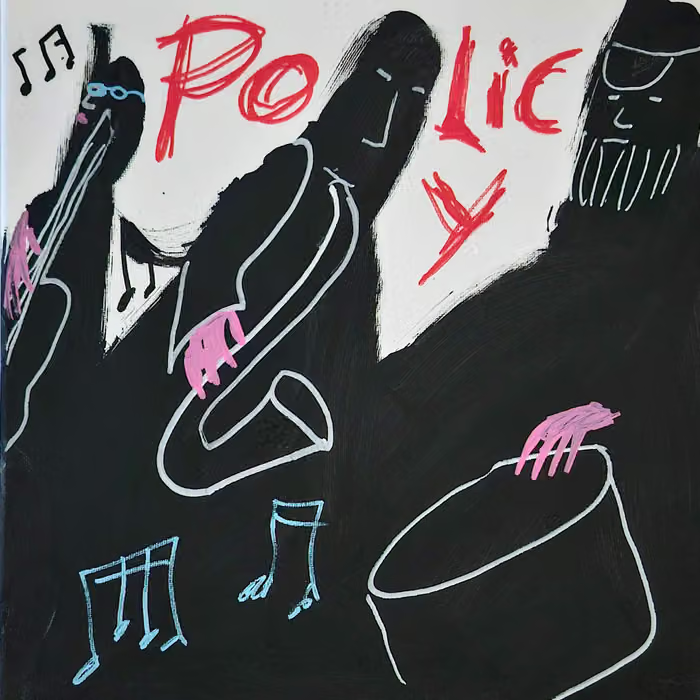
GH: In May, we’ve the Second Sight annual [show], which is strict freeform. With that, we have Policy, which is the group that I drum for, and then we have Disco Lizzards, [who] are doing a strict freeform piece too. After that, we’re gonna have the [next edition of] Investigation thru ELECTRONICS!!, which is kind of experimental electronic music and a lot of improvisation and weird sounds.
Stylus: Do you yourself perform at each one of these events?
GH: I do. I call it the curator’s benefit, which is just one of the rules. Even when I have guest curators, I get to do a set at the beginning of the night because it just seems silly for me to just show up there and not play music on a monthly basis. Very often, I’ll open just to get the opening slot out of the way. I maybe play one or two shows a year that are not at space)doxa, so it’s just good to have something to do on a monthly basis.



That sounds really interesting, I’m always keen to see more diverse performances beyond just traditional music.