Alexi Murdoch – Towards the Sun

Alexi Murdoch is a rare gift to the world of music – an artist who has earned a notable amount of fame and praise (despite his still short career) but also one who has remained humble, spiritual and honest. Alexi Murdoch’s first album was sensitive and penetrating to the core, and his newest album, Towards the Sun proves that Murdoch is going to be around for a while longer. His voice is deep and every song is universally relevant and plays off themes and emotions we can all attest to. This album speaks to all the private discourses we hold within – our fears, our loves and our hopes. Towards the Sun is Murdoch’s follow-up four years after Time Without Consequence. Towards the Sun is stunning in all its simplicity. Recorded in a 6-hour session in Vancouver whilst touring in 2009, it is stripped down and offers only the essential, as compared to TWC, which was significantly more layered, and voyaging. This album is lovely and calming, to which I attribute to the incredible mélange Murdoch’s voice makes with his guitar. This is a beautiful man with a beautiful message – at it core, music is still about provoking something within us and stirring it up. (Zero Summer Records, www.aleximurdoch.com) Victoria King

Esmerine – La Lechuza

Esmerine is an impressive collective of musicians with core members Bruce Cawdron of Godspeed You! Black Emperor and Beckie Foon of Thee Silver Mt. Zion. The album is dedicated to recently deceased musician Lhasa De Sela. Lhasa’s harpist Sarah Page, Patrick Watson and Colin Stetson all contribute to La Lechuza. “Snow Day for Lhasa” is a notable track, featuringWatson’s vocals and an austere harp melody. “Little Streams Make Big Rivers” follows the album’s orchestral theme yet is reflective of Godspeed’s brooding pace and style. “Fish on Land” is a haunting song with Lhasa’s vocals, paced slow with a minimal piano and violin composition. La Lechuza is a wonderful orchestral album. (Constellation, www.cstrecords.com) Kyra Leib

Malachi – Return to the Ugly Side

To me, album artwork plays a large role in how I judge an album before I listen to it. I guess it’s just my habit as a graphic designer. At first glance I thought for sure this album was a metal album, or hardcore somewhat, but I was found wrong. I actually thought I mixed up the CD and put in Sufjan Stevens’ Age of Adz instead. The electronic drum track in their songs sounds much like one Sufjan Stevens enjoyed using in his latest album. Malachai (formerly named Malakai) is a strong ’60s Psychedelic electronic rock group with cut and paste styles all over the album. The sleepy, spooky, fast, action, slow and calm feelings in this album, creates the perfect soundtrack for a dream. I swear if you listened you would think the same. Its spot on for any dream scenario. (Double Six, www.dominorecordco.us) Nicholas Van Doeselaar

Fear of Music: The Price of Art

By Devin King

It’s said that someone suggested to Winston Churchill that he should cut funding to the arts in order to pay for the war effort. Churchill then replied, “Then what would we be fighting for?” Even though there’s not much proof that conversation ever happened, it’s still a good sentiment. This quotation illustrates that one of the hallmarks of a great society – indeed, maybe even humankind – is respect and appreciation for the arts. We are lucky then, to have the Polaris Music Prize as a means to recognize talented Canadian artists. This recognition is problematic though, on a few levels.
The first problem revolves around the criteria for winning the Polaris Prize. The criteria listed quite obtuse, with nominations going to acts who are “creative” and “diverse” as well as those which feature the “highest artistic integrity.”
Imagine taking all of your CDs and ranking them in order of creativity. It might be easy to separate the extremes—say, Len’s You Can’t Stop the Bum Rush on one end and Broken Social Scene’s You Forgot it in People on the other. But even then, it’s problematic because there is no set universal criteria for great music. One of the problems of “great” music is that the definition of great is largely created by the critics who are not necessarily the audience. (Elijiah Wald discusses this in his book How the Beatles Destroyed Rock ’n’ Roll.) So while Len might not have the artistic integrity required to be a Polaris Prize winner, a lot of people once seemed to think their music was pretty good.
The Junos or Grammys are often heavily influenced by sales success, so awards given have a certain mathematical definition to them, even if people don’t agree with the outcome. But in the case of Polaris, the parameters are more are less “artisticness.” Maybe separating Len and Broken Social Scene is easy, but how do we decide if The Weeknd is more artistic than Neil Young?
The second problem involves receiving a financial prize. As a teacher, I believe that if someone does something wrong, then the consequence should match the mistake. So if you are caught spray painting a car, it would make more sense for you to hold a free car wash as a consequence than be made to write lines. I think the same might be true of positive actions as well.
This year, the big prize is $30,000, which is $10,000 more than last year. Additionally, every artist or band nominated for the short list will receive $2,000. It’s a lot of money that can provide lots of opportunities for bands. You can record a charity single like 2009 winners Fucked Up, support other bands financially like 2006 winner Owen Pallett or fade into utter obscurity like Patrick Watson in 2007.
$30,000 is a lot of free money to give away. Granted, winners have shown how they can use that money to support their communities, both in the musical and non-musical realms, but I don’t see the connection that means that great music deserves increased wealth. It certainly would allow for the further creation of great art, but offering up the cheque seems like a philosophical disconnect between why we make art and how we reward art.
It seems like a prize more in line with the parameters of a great artist outlined by Polaris would simply be recognition. And sure, recognition will probably lend itself to money. Perhaps there is another prize more reflective of artistic integrity. Maybe the prize should just be the title itself.
Regardless, when the arts are supported, it’s a good thing for society. But how, why and who we reward it are also important factors to consider in order to truly understand how our society perceives art.


El Boy Die – The Black Hawk Ladies & Tambourins

At this point in reviewing music, I should learn to be more cautious about buying the hype that promoters and press releases sell to attract listeners, but I’m an eternal optimist. Promises of an album for fans of Devendra Banhart accompanied France-by-way-of-Montreal artist El Boy Die and ‘his’ debut The Black Hawk Ladies & Tambourins.
I get where the person who wrote the one-sheet was coming from, but the material on Black Hawk is far less freaky and a little less folk than Banhart’s output.
In fact, calling it freak-folk is a bit of a misnomer – the music is dark and psychedelic but it lacks the joyful, anarchic spirit that pervades the music of freak-folkers like Banhart.
Labels aside, Black Hawk… is a well recorded album that creates an ominous atmosphere the hollowed-out toms and chorus of atonal voices on “Dead Kings” is spooky as hell and El Boy Die is unrelenting in keeping the listener on edge – this reaches it apotheosis on “Man Eagle,” which for four minutes is the standout track; that is until the field-recording of a pow-wow closes the song out. It’s not just some ‘cool’ atmosphere – it’s cultural misappropriation and a misstep in an otherwise promising record. (Semprini Records, www.semprinirecords.com) Michael Elves

We are Enfant Terrible – Explicit Pictures


We are Enfant Terrible resurrects Nintendo from its ’80s grave with the release of their new album, Explicit Pictures. The trio (Thomas Fourney, Clo Floret and Cyril Debarge) comes out of Lille, in Northern France.  We are Enfant Terrible is dastardly catchy hipster pop. The album was recorded at Fourney’s house in Lille, with the band utilising guitars, keys, drums, Nintendo and 8-bit music. For those of you who scratch your heads and say to yourself, “8-bit? Double-you-tee-eff?” let me save you the time and energy of Wikipedia. 8-Bit is electro pop created via yesteryear’s game consoles, like Atari and/or Gameboy. Loving the “purity” of the Nintendo, these three use the “smooth and aggressive” tones of the Nintendo to forge Explicit Pictures into the mod music of 2011. They also list fashion, ’50s, ’60s and ’70s pop, Roman history, Belgian cooking and kittens as sources of inspiration. Listen to it once, you’ll think it was pretty good, but nothing you haven’t heard before. The second time will come out of curiosity. Third time? This was no accident. A final thing to note is the lyrics – they’re pretty funny, considering the rough French-English translation but it works with the unnerving and infectious melodies.  Give “Lobster Quadrille,” “A Song to You” and “So Fine” to see for yourself. (Pil Records, http://www.weareenfantterrible.com/) Victoria King

Vetiver – The Errant Charm


Vetiver’s fifth album sounds more refined and less based on folky guitar than earlier efforts. Reminiscent of Sam Prekop, The Errant Charm is a sweet and soothing pop album. Turning away from acoustic guitar and toward keyboard, electric guitar and chill, Vetiver explores ambient pop on The Errant Charm. I really enjoy the first three songs on this album. “Worse for Wear” sounds like early Vetiver, as the song maintains an emphasis on the acoustic guitar. The Sam Prekop-type pop beginning with “Hard to Break” is nice. “Can’t You Tell” is a perfect soft pop song, a partial throwback to ’80s pop yet still maintaining Vetiver’s core sound. Overall, I am chilling to this new Vetiver album. It is very relaxing and sweet. (Sub Pop, www.subpop.com) Kyra Leib

The War On Drugs – Buzz Band Gone Wrong

photo by Graham Tolbert

By Kyra Leib
The War on Drugs, formed in 2005, was a project created by Kurt Vile of Kurt Vile and the Violators and Adam Granduciel. Now The War on Drugs has bloomed into something special. Their commendable ability to seamlessly blend American with euphoric instrumental elements reminiscent of Phil Spector’s wall of sound delivers something like the joy of experiencing your first Springsteen record.
Granduciel, who describes his Philadelphia neighbourhood as “semi-depressed,” tells me how his environment influences him. He muses that his neighborhood – where some people have been living for eight to 20 years – has a “backwoods city vibe”, but hasn’t yet been gentrified. “Some neighbourhoods are getting knocked down for new, beautiful houses and my section is still run-down,” he muses.
I imagine their music is a testament to city life. The energy inherent in The War on Drugs’ music is the same energy you’d encounter biking or walking in urban areas. That is why this band’s music is so universal. The timeless facet of their music is comparable to the neighborhood that Granduciel tells me about, this “backwoods city.” The physical and social environment that inspired the golden age of American songwriters is still present. The War on Drugs have been affected by these environments just like Bob Dylan was inspired by the American landscape or Springsteen was influenced by American politics and his Jersey roots.
The War on Drugs are often compared to Springsteen, Bob Dylan, Tom Petty and the like. This band plays punchy, adrenaline-filled highway rock ’n’ roll and does it well. Yet they never lose sight of their own identity. Granduciel explained to me that singing like Dylan is not something he ever strained for. That’s just the way his voice has always been. It is for this reason that the group is able to blend genres so well. They aren’t straining to emulate anything, it’s all them. Continue reading “The War On Drugs – Buzz Band Gone Wrong”

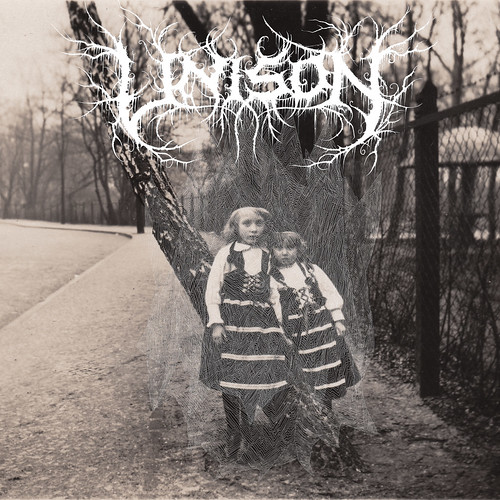
Unison – Unison

Unison – Outside by Lentonia

Unison is a French dark electro duo who are still far under the radar in Canada. Though they’ve had some singles and an EP floating around for a long time (Outside has been around for a couple of years), this is their first full length.
Unison is polished and feels like the result of a long time’s work – there’s nothing lo-fi about this. It’s a deliciously dark album you can get away with putting on in almost any situation, and is a throwback to when music was produced with care (it freaks me out to compare Slowdive’s most majestic tracks with a lot of music I’m listening to now – where is the love?), without being redundant.
A Unison review might be the perfect time to examine 2010’s witch house – Unison is one of the last good bands to still openly claim to be part of the genre. Many of the fundamentals are here: haunting feminine reverb vocals, trance elements, dubstep beats, total atmosphere, and foggy, ambiguous lyrics – missing only are the screw, the drag, and the digital tape hiss. Fans of White Ring, and Salem’s shoegaze-ier tracks, will find a new love here. Yet Unison go their own way, too, incorporating minimal interludes, Glass Candy coquette-try, and M83 / My Bloody Valentine worthy drama.
Outside is still a fascinating track after all this time, and Brothers and Sisters is a magic pop song that any artist, from Britney to Swans, would be proud to put out. The album is long, but never lags – Arp Quad Rollerskate is a light and unexpected intermission, while second to last track First Degree, 50 minutes into the album, demonstrates the kind of emotive power Unison are wielding.
Unison are easy to compare to other acts, both past and contemporary, but that doesn’t mean they don’t hold their own ground and build something genuine on it. These are artists to give your heart to. (Lentonia Records, http://lentonia.com/) Kristel Jax

Thus Far and Thenceforth

Week Thus Far goes further with Season Two
By Lara Violet

If you are still channel surfing, you may have caught wave of local Shaw TV comedy Week Thus Far, styled after late night talk shows with the host/guest/live band paradigm, but enjoying the zany liberties allotted to public access programming. If you have decided to take your television viewing habits into your own double-clicking hands online, you may be missing out on the bizarre beauty of local DIY TV.

Development of Week Thus Far began when producer Craig Ward got the job of “Master Controller” at Shaw, and approached future WTF host Dan Huen about starting a talk show. With various burgeoning ambitions to start a sketch comedy group, rounding up hilarious talent was almost instantaneous, even though the vision was uncertain. “Nobody knew what this was or was going to be, we knew we wanted jokes, a guest and a band. Beyond that we had nothing pre-conceived. The meetings began to be about whether or not we could actually provide the content,” writer/producer Tim Gray explained. Continue reading “Thus Far and Thenceforth”